
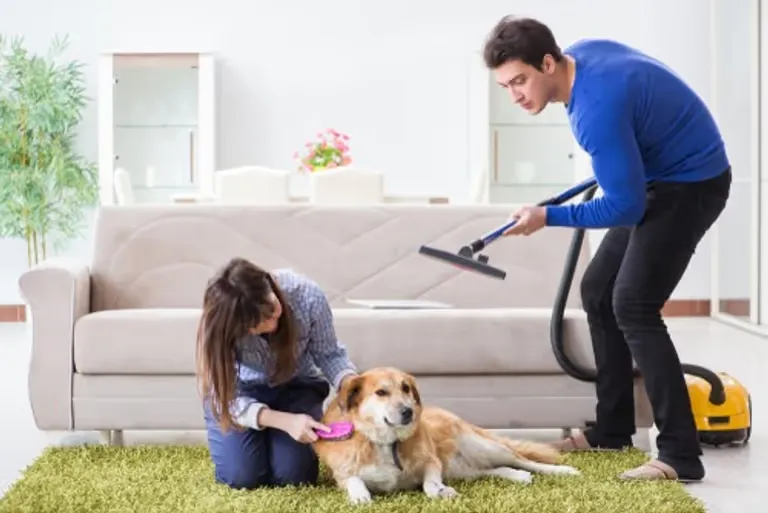
Most questions about cleaning products and pets are really one question: is the thing under my sink going to hurt my dog or my cat. The honest answer is that almost nothing in a normal cleaning cabinet is dangerous the way people picture it, and almost all of it is dangerous in one specific way people do not picture.
Is Fabuloso safe for dogs?
Fabuloso is safe around dogs once it has been used as directed and the floor is dry; the risk is contact with the concentrate or with a wet, freshly cleaned floor. The full answer is in our guide to whether Fabuloso is safe for dogs.
Is lavender essential oil safe for cats?
No — cats lack the liver enzyme that processes the phenols and terpenes in essential oils, so lavender oil is not safe around them in diffused or applied form. The full answer is in our guide to whether lavender essential oil is safe for cats.
Is Pine-Sol safe for dogs?
Pine-oil cleaners deserve more caution than a plain detergent, and more again around cats than dogs. Pine oil appears on Pet Poison Helpline's list of oils that cause poisoning in animals. Used diluted, on a floor left to dry fully, with the pet out of the room, the exposure is small.
Formulations change over the years, so read the label on the bottle you actually own rather than trusting what a cleaner contained a decade ago. If pine oil is in it, treat it as a product to dilute, ventilate and dry, not one to leave puddled.
One label detail worth knowing on any product. If a cleaner genuinely kills germs, it carries an EPA registration number on the label, because disinfectants are registered with the federal government. No EPA registration number means the product is a cleaner, not a disinfectant, regardless of what the front of the bottle implies.
What cleaning products are safe for pets?
The safest product is the one used correctly, which is why habits matter more than brands. Dilute to the label, ventilate the room, keep the animal out until surfaces are dry, and store everything closed and out of reach. Most pet poisonings involve the container, not the cleaned surface.
Beyond that, the choices that genuinely lower risk:
- Choose unscented or lightly scented. Fragrance is the ingredient most likely to bother an animal's airway, and heavy scent also encourages a dog to lick a floor.
- Read the ingredient list for essential oils if you have a cat or a bird, especially tea tree, citrus, pine, eucalyptus and wintergreen.
- Skip aerosols and air fresheners. Birds in particular have respiratory systems that do badly with anything airborne, including aerosol sprays and overheated nonstick cookware.
- Never mix products. Bleach with ammonia is the well-known one, but mixing anything with anything is a bad habit.
- Move the animal, not just the bottle. Cleaning with the dog crated in another room or the bird in a different part of the house removes most of the risk for free.
- Check a specific product rather than a brand. The EPA's Safer Choice program certifies individual products whose ingredients meet its standard, and its searchable list is a better guide than the front of a label.
Are Method and Mrs. Meyer's cleaning products actually non-toxic?
Both disclose more than most brands and neither is a hazardous product, but "non-toxic" is not a regulated claim and the scented lines contain fragrance compounds. The full answer is in our guide to whether Method and Mrs. Meyer's are really non-toxic.
How do you keep a house clean with a dog?
Catch hair and dirt before they spread rather than chasing them afterward. Brushing the dog outside, wiping paws at the door and vacuuming the two or three paths the dog actually walks will do more than any product. Most of what makes a dog household feel dirty is hair and outdoor grit, not stains.
The routine that holds up:
- Brush outside, on a schedule. Hair caught on the step is hair that never reaches the sofa.
- Keep a towel at the door and wipe paws after walks, particularly in a Chicago-area winter when salt comes in with them. Road salt is also hard on paws and on hard floors.
- Vacuum the traffic paths twice a week rather than the whole house once. A robot vacuum on the off days handles the rest.
- Damp-mop hard floors with a well-wrung mop. Do not wet-mop unsealed or unfinished wood, and never let water stand on a seam.
- Use an enzyme cleaner on accidents and blot rather than rub. Avoid ammonia-based cleaners on urine, because ammonia smells like urine to a dog and invites a repeat in the same spot.
- Wash the dog bed cover weekly and vacuum the bed itself. It is the single largest reservoir of hair and dander in most homes.
On the baking soda trick for carpets and beds, one caution the internet leaves out. Sprinkle it sparingly and vacuum thoroughly, because fine powder can clog filters and is hard on some vacuum motors. Check your vacuum's manual before you make a habit of it.
If someone in the house reacts to the animal rather than to the mess, the Asthma and Allergy Foundation of America's guidance on dog and cat allergies is a better starting point than another cleaning product. Frequent vacuuming, washing bedding hot and keeping the animal out of the bedroom do more than anything sprayed.
What does Happy Maids use, and what if you want something different?
Happy Maids provides all cleaning tools and supplies. Plant-derived Better Life products handle glass, floors, wood, stainless steel, granite and stone, and the kitchen and bath scrubber. Bleach-based and other products are used for specific jobs such as stains and toilets. The full supply list is published on our green cleaning page.
That matters in a house with animals, so it is worth being specific rather than reassuring. If a product matters to you because of a pet, a bird or an allergy, call the office before your first visit and ask what we use in the rooms you are concerned about.
We can talk about using something of your own, and clients sometimes do. We have to be straight about the trade-off, though: when technicians use client-supplied products, tools or equipment, Happy Maids cannot assure our usual standard of cleaning and cannot take responsibility for damage to surfaces or equipment resulting from those materials. That is published on our policies page rather than buried.
There is a working middle ground, and it is the same one we use for ovens. A client who prefers a particular product can apply it themselves before we arrive, and our technicians clean it up as part of the visit.
What Happy Maids will not do in a home with pets
We clean around animals every day, and there are a few things we do not take on. Saying so in advance is better than a technician standing in your kitchen having the conversation.
- Happy Maids does not clean homes infested with fleas, and does not remove animal waste of any kind.
- We do not clean carpets or steam clean, so a set-in pet stain in a carpet is a carpet cleaner's job.
- If a cleaner feels threatened by an animal in the home, we reserve the right to refuse service.
- Please secure pets before a visit. If the crew cannot work because an animal is loose, that counts as a lockout and is charged at the full cleaning cost, so it is worth a note to the office if your dog needs a closed door.
What we do instead is the ordinary work that keeps a pet household comfortable: hair off floors and upholstery, hard floors mopped, bathrooms and kitchens scrubbed, and dust taken off the horizontal surfaces where dander settles. The room-by-room cleaning checklist shows exactly what is included on each service, and vacuuming inside a sofa is available as an add-on with at least one business day's notice.
Homes with pets tend to do better on a shorter interval, which is why most of our pet clients run a recurring plan after an initial deep clean. If odor rather than mess is the real problem, our post on keeping a house with pets smelling good goes further into that, and our green cleaning post covers the wider question of what "green" is worth on a label.
Happy Maids has been family owned and cleaning homes in the northwest suburbs of Chicago since 1985. Call 847-382-0082 Monday through Friday, 8:30 AM to 4:30 PM, and a person answers.
Frequently asked questions
Is Fabuloso safe for cats?
The same rules apply as for dogs, with one addition: cats groom, so anything that lands on their paws or fur ends up swallowed. Dilute to the label, keep the cat out of the room until the floor is completely dry, and empty the mop bucket immediately. Cats are also more sensitive than dogs to fragrance compounds, so an unscented floor cleaner is the safer default in a cat household.
Does Lysol kill dust mites?
Disinfectant sprays are registered to kill bacteria, viruses and fungi, not dust mites, and killing a mite would not solve the problem anyway. The allergen is in mite droppings and body fragments already embedded in mattresses, bedding and upholstery, and it stays there after the mite dies. What actually reduces exposure is removal: washing bedding weekly in hot water, allergen-proof mattress and pillow encasements, vacuuming with a HEPA filter, and keeping indoor humidity down.
Is vinegar safe for cats?
Diluted white vinegar is one of the lower-risk things in a cleaning cabinet around cats, and most cats avoid it on their own because they dislike the smell. Undiluted vinegar can irritate eyes, nose and skin, and a cat that licks it will drool. It is not a disinfectant, so do not use it where you need to kill germs. Never mix vinegar with bleach, which releases chlorine gas.
How do you clean baseboards with vinegar?
Mix roughly one part white vinegar to ten parts warm water, wring the cloth until it is barely damp, and wipe along the top edge first, then the face. Dry with a second cloth so no moisture sits at the floor seam. Do not use vinegar on natural stone such as marble, travertine or limestone, on unsealed or waxed wood, or on paint that has not fully cured, since latex needs two to four weeks. Honestly, warm water with a drop of dish soap works just as well on painted baseboards and is gentler on the finish. Skip melamine sponges on gloss, semi-gloss or older painted trim, because they abrade the sheen.
Is Mrs. Meyer's actually non-toxic?
Nobody can tell you from the label, because "non-toxic" is not a regulated term for household cleaners. The FTC's Green Guides are designed to help marketers avoid environmental claims that mislead consumers, and the American Lung Association notes that manufacturers are not obligated by U.S. law to list all ingredients and that products labeled "green" do not necessarily mean they are safer. Look up the exact product and scent on the EPA Safer Choice list, and if you have a cat or a bird, read the ingredient list specifically for essential oils.
What should I do if my dog licked cleaner off the floor?
Move the dog away from the area, rinse the floor with plain water, and offer a small amount of water or food to dilute anything swallowed. Do not make the dog vomit unless a professional tells you to. Call your veterinarian, Pet Poison Helpline at 855-764-7661 or the ASPCA Animal Poison Control Center at 888-426-4435, and have the product container in front of you so you can read the ingredients and concentration to them. A consultation fee applies at both.
How do you make a non-toxic cleaning product at home?
For most surfaces, warm water with a little dish soap does the job. Baking soda made into a paste works for scrubbing sinks and tubs, and diluted white vinegar cleans glass. Three cautions: homemade mixes do not disinfect, vinegar must never be used on natural stone, unsealed wood or uncured paint, and you must never combine vinegar or ammonia with bleach.
Do house cleaners use pet-safe products?
Ask before the first visit, and ask about the specific rooms you care about. Happy Maids provides all cleaning tools and supplies. Plant-derived Better Life products cover glass, floors, wood, stainless steel, granite and stone, and the kitchen and bath scrubber, while bleach-based and other products are used for specific jobs such as stains and toilets, and the full supply list is published on our green cleaning page. If you would prefer we use something of your own we can discuss it, but we have to tell you plainly that we cannot assure our usual standard of cleaning or take responsibility for damage to surfaces or equipment from client-supplied materials.