
Recurring Maid Service Barrington area, since 1985
Recurring house cleaning is an ongoing arrangement: the same Happy Maids team cleans your home on a set rhythm — weekly, every two weeks, or every four weeks — holding a standard rather than rescuing a house. You keep the same day, the same faces, and a scope built around how you actually live.
Choosing your rhythm
Most people who call us are not looking for one good clean. They are looking to stop thinking about it. The right frequency depends less on how big your house is than on how hard it gets used, and we would rather help you pick correctly than sell you more visits than you need.
Weekly — a house that is genuinely in use
Two or three children, a dog, a back door that never stays shut, and a kitchen that gets cooked in every night. In a home like this, a week is about how long a clean holds. Weekly clients rarely describe themselves as tidy people; they describe themselves as busy ones. The visits are shorter than you would expect, because nothing is ever allowed to build up.
Every two weeks — the one most people choose
This is our most common schedule and, for the majority of homes in Barrington, Inverness and Lake Zurich, the right one. Fourteen days is long enough that the visit still makes a visible difference, and short enough that soap film in the shower, dust on the sills and grease above the range never get established. If you are unsure where to start, start here.
Every four weeks — quieter homes
Couples without children at home, empty nesters, people who travel most of the month, a second home used on weekends. There is less traffic, so there is less to hold. We usually spend a little longer on a monthly visit than a biweekly one, because four weeks of dust is genuinely more dust — and we will tell you honestly if your home is busier than a monthly schedule can carry.
Handing it off for the first time
A lot of our clients cleaned their own homes for years and stopped for a reason: a new job, a knee, a parent who now needs looking after, a baby. If you have never hired a cleaning service, you are not expected to know the vocabulary or what to ask. Tell us about your house on the phone and we will do the translating.
Replacing someone who stopped showing up
This is the call we get most often. The independent cleaner canceled twice, then went quiet. The franchise sent four different people in four visits. We employ our cleaners as W-2 staff, background-checked, bonded and insured, and on weekly and every-two-week schedules we hold the same team on your home. When someone is ill or on holiday, the office calls you before the day, not during it.
What a recurring visit covers
A maintenance visit is not a lighter version of a deep clean — it is a different job. The heavy work has already been done once; recurring cleaning holds it. Below is what that means in practice in most homes. The complete room-by-room list lives on our cleaning checklist, and your plan is written from it, not copied from it.
- Kitchen: counters cleared and wiped down, backsplash, sink and faucet scrubbed clear of hard-water film, cooktop and the front of the range, microwave inside and out, and the exterior of the refrigerator and dishwasher — handles included, since they are touched more than anything else in the room.
- Bathrooms: toilets cleaned base to lid and behind the pedestal, tubs and showers scrubbed, glass and tile worked for hard-water film before it can etch, mirrors, and chrome dried by hand so it does not spot.
- Floors vacuumed with sealed-HEPA SEBO machines — the seal matters, because a leaking vacuum returns fine dust to the room — then mopped in detail, into corners and along edges. We do not clean floors on our hands and knees. We mop, carefully.
- Dusting worked high to low: light fixtures and fan blades within reach, shelves, picture frames, lamps, window sills and ledges, then the surfaces beneath them, so nothing that falls is left behind.
- Hand-washed surfaces where fingers land: cabinet fronts, doors and door frames, switch plates, handrails and painted trim.
- Baseboards dusted on every visit — which only works because they were washed properly at the start. You cannot maintain something that was never cleaned in the first place.
- Beds made, or linens changed if you leave fresh sets out on the bed.
- Bins emptied and relined, in every room that has one, not only the kitchen.
- Rotating extras on a cycle you choose: interior windows, inside the refrigerator or oven, closet floors, the finished basement every second visit. Occasional jobs do not need to happen every time to stay under control.
- Rooms deliberately left alone. A home office you would rather we did not touch, a teenager's bedroom, a guest room that is never used — we note it once and it stays noted.
Every task, side by side across recurring, deep and move-out cleans, is on the house cleaning checklist.
Call 847-382-0082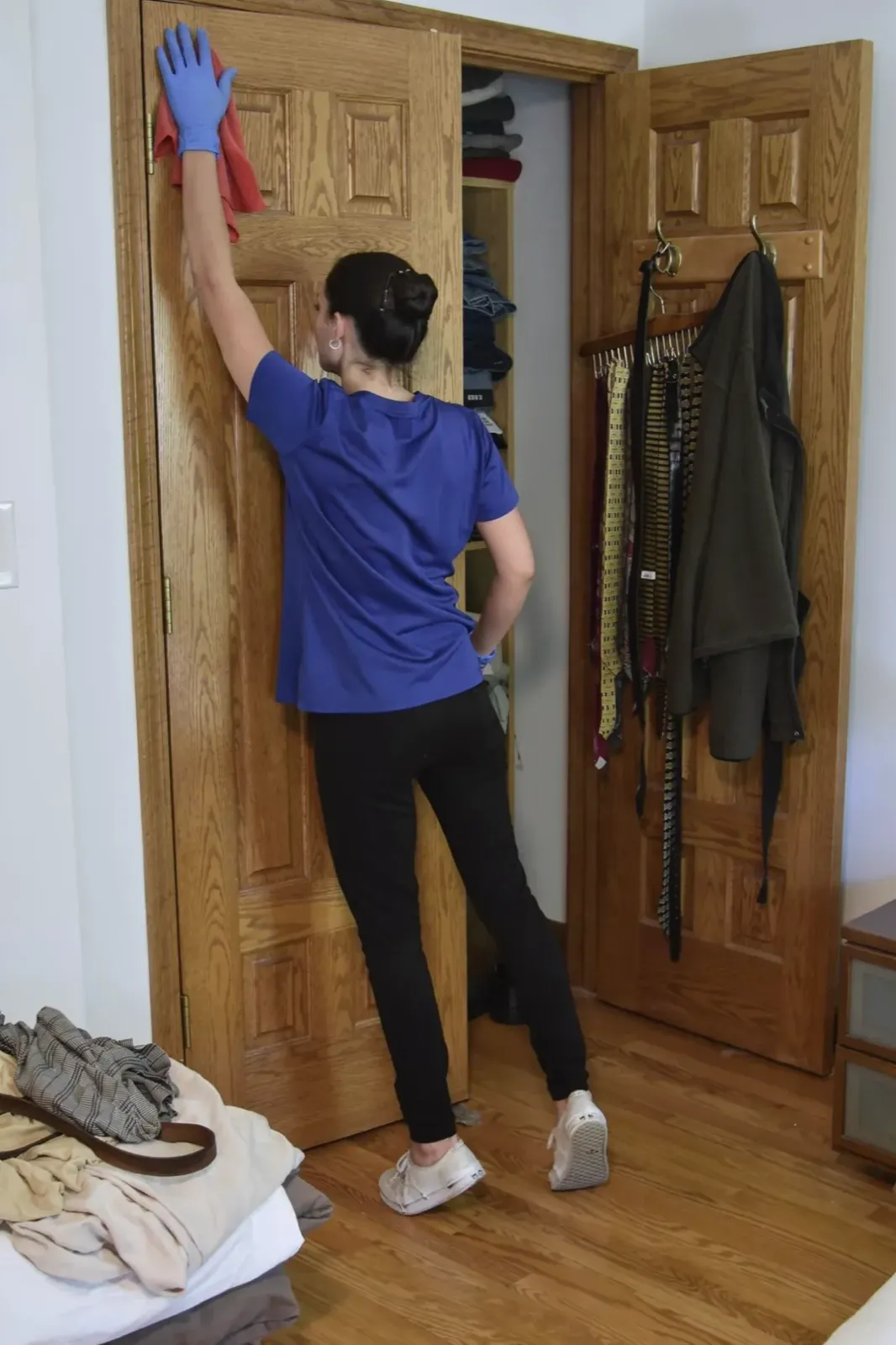
How it actually works
A phone call, not a form
Call 847-382-0082 during office hours and a person in our Lake Barrington office answers — not a menu, not a chatbot. We ask about the house: square footage, how many bathrooms, pets, floors, how long since the last thorough clean. Ten minutes on the phone tells us more than any online calculator. You can also text the same number if that is easier.
We price by time, and we say so
Recurring cleaning is priced by the time a home actually takes, with a minimum visit length. There is no package table on this page because there is no honest one to publish — a four-bedroom in Barrington Hills with three dogs and a four-bedroom in Deer Park with none are not the same job. We give you a realistic range on the call and confirm it after the first visit.
The first clean sets the base
Whether your home needs an initial deep clean depends on its condition, and we will be straight with you about it. If baseboards, grout, vents and the tops of door frames have not been washed in a long time, a deep clean first is what makes every visit afterwards fast, consistent and worth the money. If your home is already in good shape, we skip it and start straight on the recurring schedule.
The same team, the same day
A standard visit is a team of two; homes over roughly 3,500 square feet get a team of three. We schedule you a fixed day, and on weekly and every-two-week service we send the same people back to it for as long as they are with us. This is the part clients notice most by month three — the team knows which shower has the hard water problem, which floor cannot take too much moisture, that the dog is fine but the cat bolts, and where the vacuum plugs in without tripping the breaker. Nobody has to be told twice.
What comes through your door
Green, kid- and pet-safe products on every visit, as standard and at no extra cost — never an upsell. Sealed-HEPA SEBO vacuums. Color-coded microfiber cloths, so a cloth used in a bathroom cannot end up on a kitchen counter. We bring everything; you do not need to keep supplies on hand, though we will happily use a product of your own on a surface you are particular about.
You do not need to be home
Most of our recurring clients are at work. We hold keys and codes securely and let ourselves in — that is the norm, not the exception. Your preferences live in a file attached to your home, so a change you mention once in April is still being honored in November.
If something is not right, we come back
That is the Happy Home Guarantee. Call the office, tell us what was missed, and we return and re-clean it at no charge. There is no contract to sign and no minimum term — it is at-will. You can move a visit, skip a month while you are away, or change frequency by calling us. Give us at least two full business days' notice on any change or cancellation and there is nothing to pay.
How recurring differs from a deep clean
This page is about the ongoing relationship. Its nearest sibling, deep cleaning, is about a single heavy reset — washing baseboards for the first time, breaking down built-up soap film, the tops of door frames, behind and under what does not normally move — and for most homes that is a first visit, not a repeating one. The two are sequential, not competing: the deep clean establishes a base, and recurring cleaning is the lighter, faster work that holds it. That is why the task list here is shorter and different, and why you will not find "washing baseboards" on this page but you will find "dusting baseboards". If you want to know what an initial deep clean involves, the deep cleaning page covers it. This page covers what it takes to keep it that way.
What does recurring maid service cost?
Happy Maids prices every clean by the time a home honestly takes — square footage, how many bathrooms, and the condition it is in right now. Two very different homes should not pay the same number, so we do not pretend they do.
Run the quick estimate for a ballpark, then call us for your exact price — free, no obligation, and a real person answers.
- Home size & baths — the two biggest levers.
- How often we come — recurring visits lower the per-clean rate.
- Add-ons — inside oven or fridge, interior windows, and more, on request.
You don't have to have the whole house cleaned. Plenty of clients have us clean only the rooms they use, alternate floors between visits, or skip tasks they handle themselves. Read what you can change.
A ballpark to get you oriented — for your exact price, give us a call. Free, no obligation, and a real person answers. Backed by the Happy Home Guarantee · ★ 4.8 from 161 Google reviews · BBB A+.
Recurring cleaning, answered
How often should we have you come — weekly, biweekly, or monthly?
Every two weeks suits most homes and is what the majority of our clients choose. Go weekly if the house is heavily used: young children, pets, a kitchen that gets cooked in nightly. Go to every four weeks if the home is quiet — a couple who travel, an empty nest, a weekend house. Frequency is not permanent. Plenty of clients run weekly through the winter and drop to biweekly when the family is outdoors more, then move back. Tell us about the house on the phone and we will recommend the one we would choose ourselves.
Will I get the same cleaners every time?
That is how we schedule it, and it is the single biggest reason to use us rather than a franchise. Our cleaners are our employees — W-2, background-checked, bonded and insured, not gig workers assigned by an app — so we can hold them to the same route week after week. Illness and holidays happen, and when they do the office calls you in advance rather than surprising you with strangers at the door. Someone who already knows the home always leads the visit.
Do we need a deep clean before starting a recurring schedule?
It depends entirely on the condition of the home when we start, and we will look before we answer. If the house has been maintained and the last thorough clean was recent, we can begin recurring straight away. If it has been a few years, an initial deep clean first is what makes everything after it work — you cannot dust a baseboard on every visit unless someone washed it properly once. We will tell you honestly which one applies to your home, and we have talked plenty of people out of the deep clean.
What does recurring cleaning cost?
We charge by the time a home takes rather than a flat package rate, and there is a minimum visit length. We do not publish package prices because homes are not packages — the same floor plan can take very different amounts of time depending on flooring, pets, clutter and how long it has been since the last clean. Call 847-382-0082 and we will give you a realistic range in a few minutes, then confirm the actual figure after we have been in the house once. If you want a rough figure before you call, the estimate tool will get you close.
Am I locked into a contract?
No. There is no contract and no minimum term — it is at-will. Recurring simply means we hold a regular slot for you. If you want to pause while you are traveling, move a visit around a holiday, or stop altogether, you call the office and we sort it out. Give us at least two full business days' notice and there is nothing to pay. We would rather keep clients because the work is good than because the paperwork makes leaving awkward.
Do I need to be home when you clean?
Most of our recurring clients are not. We keep keys and entry codes securely and let ourselves in, which is the normal arrangement rather than a special one. If you prefer to be there, that is fine too — you can go about your day and we will work around you. Whatever you decide, it is recorded on your file so nobody has to ask again.
Can we change what gets cleaned?
Yes, and most people do within the first few months. Add the interior windows twice a year, put the guest room on a rotation instead of every visit, ask us to leave the home office alone entirely, or have the fridge done inside each spring. Say it once and it goes on your file. If you want to build the plan around specific priorities from the start, our custom plans page explains how that works.
Are the products safe around children and pets?
Yes. Green, kid- and pet-safe products are what we use on every visit as standard — it is not a premium option and it does not cost extra. We pair them with sealed-HEPA SEBO vacuums, which keep fine dust inside the machine rather than blowing it back into the room, and with color-coded microfiber so bathroom cloths never touch a kitchen surface. Our green cleaning page has the detail if you want it.
What happens if something gets missed?
Call the office and we come back and re-clean it at no charge. That is the Happy Home Guarantee, and it is the reason we prefer clients to tell us straight away rather than quietly stop booking. Over the years we have found that most problems are one detail on one visit, and they get fixed permanently once they are on the file.
Which towns do you serve?
We work from one office in Lake Barrington and cover around 40 towns across the northwest suburbs — Barrington and all the Barringtons, Inverness, Deer Park, Lake Zurich, Palatine, Arlington Heights, Schaumburg, Crystal Lake, Algonquin, Long Grove and neighboring communities in Lake, Cook, McHenry and Kane counties. Our service areas page has the full list.
What does bi-weekly cleaning mean?
Bi-weekly cleaning means we come every two weeks — twice a month on a fixed day, not twice a week. It is the most common schedule we run, and for most homes it is the point where a clean still holds: fourteen days is short enough that shower film, dust on the sills and grease above the range never get established. Some people call it every-two-week.
How much does bi-weekly house cleaning cost?
There is no flat rate, because a 1,800 square foot townhouse and a 5,000 square foot house are not the same job. We price by the time a home actually takes, and the time is driven by square footage, how many bathrooms there are, and the condition the house is in when we start. Frequency matters too — a home cleaned every week takes less time per visit than the same home cleaned every four weeks, because less has built up. Use the estimator on this site for a ballpark, then call 847-382-0082 and we will give you your real number for free. Try the estimate tool for a ballpark, then call for the actual figure.
What is on a bi-weekly house cleaning checklist?
Every room gets floors vacuumed and mopped, surfaces dusted, bins emptied, and the kitchen and bathrooms cleaned properly — counters, sinks, faucets, toilets, showers and tubs, and the microwave inside and out. Our full checklist shows every task side by side across recurring, deep and move-out cleaning, so you can see exactly where the lines fall rather than taking our word for it.
How do I know whether to book weekly, bi-weekly or every four weeks?
It depends far less on the size of the house than on how hard it gets used. Children, pets and cooking every night push you toward weekly. Two adults who work all day, or a house that is empty half the month, do fine on four weeks. Most homes land on every two weeks. If you are not sure, start bi-weekly — it is easier to judge from there, and we will tell you honestly if we think you are on the wrong schedule.
What does a recurring cleaning service actually mean?
It means an ongoing arrangement rather than a single job: the same day on a fixed rhythm, and on weekly and every-two-week schedules the same team. You are not rebooking each time and you are not explaining your house to a stranger every visit. There is no contract — you can change the schedule or stop whenever you like.
Does a house cleaned weekly cost less per visit than one cleaned monthly?
Per visit, yes. Four weeks of dust really is more dust, so a monthly visit takes longer than a weekly one in the same house. Over a month, more frequent cleaning still costs more in total — you are simply paying less for each visit. If the total is what matters to you, say so on the phone; there is usually a schedule that fits. Try the estimate tool for a ballpark before you call.
How do I reduce the dust in my house?
Reduce what creates dust, then remove what settles instead of pushing it around. Household dust is mostly shed skin, fabric fibers, pet dander and soil walked in from outside. Sealed-HEPA vacuuming, damp microfiber, clean furnace filters, shoes off at the door and fewer fabric surfaces do most of the work.
What actually lowers the dust load in a home:
- Vacuum with a sealed machine. A HEPA filter only helps if the body of the vacuum is sealed around it. An unsealed vacuum pulls dust in and pushes the finest particles back out through its seams while you push it across the room.
- Wipe with damp microfiber, never a feather duster. A dry cloth lifts dust into the air and it lands on the same surfaces within the hour. Damp microfiber holds it and carries it out.
- Work high to low. Light fixtures and shelves first, furniture next, floors last, so anything that falls gets picked up rather than cleaned twice.
- Change the furnace and air conditioning filter on schedule. A loaded filter stops pulling particles out of the air. That job is yours, not a cleaning service's.
- Stop it at the door. A mat outside and a mat inside, and shoes off, keeps out road grit, pollen and soil that otherwise gets ground into carpet and re-released for months.
- Hold indoor humidity between 30 and 50 percent. Damp air feeds dust mites. Very dry winter air lets fine dust drift further before it settles.
- Thin out the dust traps. Open shelves of ornaments, heavy drapes, stacks of paper and decorative pillows all collect dust and release it back.
- Wash bedding weekly. Shed skin is a large share of household dust, and most of it is shed where you sleep.
Happy Maids works high to low and vacuums with sealed-HEPA SEBO machines on every visit, so the dust leaves the house rather than moving to the next room. The room-by-room detail is on the house cleaning checklist.
What kills dust mites instantly?
Nothing kills dust mites instantly. No spray, fogger or gadget wipes out a mattress population in one pass — the mites live deep inside fill and fabric, and their allergen is a protein in their waste that survives the mite. What works is heat, humidity and repeated removal.
What genuinely reduces dust mites:
- Wash bedding weekly at 130°F or hotter. That is the temperature that kills them. A cooler wash rinses allergen away but leaves the population alive, so if your water heater is set lower for scald safety, follow the wash with a full hot cycle in the dryer.
- Keep indoor humidity under 50 percent. Dust mites take water from the air rather than drinking it. Below roughly half humidity they stop thriving, which is why a humid Illinois August is harder on an allergic household than January.
- Use allergen-proof encasements on the mattress, box spring and pillows. They kill nothing. They put a barrier between you and what is already living in the fill.
- Vacuum weekly with a sealed HEPA machine, including the carpet and floor around and under the bed, where the heaviest allergen settles.
- Freeze what cannot be hot-washed. A soft toy sealed in a bag overnight in the freezer kills the mites in it. Wash it afterward, because the allergen is still there.
The honest limit: no cleaning routine removes dust mites from a home that has bedding, carpet and upholstery in it. The goal is a lower load held steady, which is a maintenance problem rather than a one-time one.
How do I know if I have dust mites?
Assume you have them. Dust mites live in almost every home with bedding, carpet or upholstery, and they are far too small to see — about a third of a millimeter, translucent, buried in fill. The evidence is a symptom pattern, not a sighting: congestion and sneezing that are worst in bed and on waking.
Signs that point to dust mites rather than a cold or pollen:
- Worse in the morning, better after a few hours up. You have just spent eight hours with your face in the biggest reservoir in the house.
- Worse indoors, better outside. That is the reverse of a seasonal pollen allergy, which eases when you shut the windows.
- Year-round rather than seasonal, often peaking in humid late summer instead of spring.
- It eases on vacation and returns within a day of coming home.
- No fever and no aching, and it lasts longer than the week or so a cold takes to clear.
Home test kits measure allergen in settled dust, but they cannot tell you whether you personally react to it. A skin-prick or blood test through an allergist is the only way to confirm that. One thing worth saying plainly: dust mites are not a housekeeping failure. A well-kept home has them too, because they eat shed skin and live wherever people sleep.
Does Lysol kill dust mites?
No. Lysol is a disinfectant built for bacteria and viruses on hard surfaces, and spraying a mattress does not reach mites living inside the fill. Some aerosols claim to reduce allergen on soft surfaces, but the allergen sits in mite waste, and waste has to be washed or vacuumed out.
What to do instead of spraying fabric:
- Hot-wash bedding weekly at 130°F, or finish with a full hot dryer cycle if your water runs cooler.
- Encase the mattress and pillows so what is already in the fill stays in the fill.
- Vacuum the bedroom weekly with a sealed HEPA machine, floor included, not just the visible carpet.
- Hold humidity under 50 percent, which does more than any product on this list.
There is also a cost to fogging soft furnishings with disinfectant: you add chemical residue to the fabric you sleep on and get nothing back for it. Happy Maids uses green, kid- and pet-safe products as the default on every visit, which is part of the same reasoning — the point is to remove what causes the reaction, not to spray over it.
Do air purifiers really get rid of dust?
Partly. A HEPA air purifier captures dust that is airborne — fine particles, dander, pollen, smoke — but it cannot lift what has already settled on a shelf or into carpet, and most dust settles within minutes. A purifier improves what you breathe. It does not keep surfaces clean.
How to get real value out of one:
- Match it to the room size and run it continuously on a low speed rather than in bursts on high. Air has to pass through it repeatedly to make a difference.
- Put it in the bedroom. That is where you spend a third of your life, and where dust mite allergen concentrates.
- Keep the door closed while it runs. A purifier sized for one room cannot clean a whole floor.
- Replace the filter on schedule. A clogged unit is an expensive fan.
- Skip ozone generators and ionizers sold as air cleaners. Ozone is a lung irritant, and settled dust is unaffected either way.
The two jobs are separate. A purifier handles the fraction of dust that is floating right now. Vacuuming with a sealed machine and wiping with damp microfiber handles the rest, which is most of it.
Does having a cleaning service actually help with allergies?
Yes, when the cleaning removes dust rather than stirring it. Sealed-HEPA vacuuming, damp microfiber on hard surfaces and clean bedding lower the dust, dander and pollen load in a home. What no cleaning service can fix is ductwork, mold behind a wall or an outdoor pollen season.
What makes the difference in an allergy household:
- The vacuum has to be sealed, not just fitted with a HEPA filter. An unsealed machine leaks the finest particles — the ones that stay airborne longest — straight back into the room. Happy Maids runs sealed-HEPA SEBO vacuums on every visit.
- Damp microfiber on hard surfaces, with sills, blinds and fan blades dusted every visit and hand-washed on a deep clean, which is where years of buildup actually comes off, so dust is carried out instead of redistributed.
- Bedrooms treated as the priority room, not the last room, if that is where symptoms are worst.
- Green, kid- and pet-safe products as the default, so nobody trades a dust reaction for a fragrance and solvent reaction.
- If someone in the house is severely allergic, plan to be out during the visit and come back an hour or two later, once anything disturbed has settled.
Where the limits are: air duct cleaning is a separate trade and Happy Maids does not do it. Neither is this medical advice — an allergist tells you what you react to, and cleaning reduces how much of it is in the house. If the home has years of buildup on baseboards, vents and door frames, an initial deep clean is what makes the recurring visits actually hold.
How often should you have your house cleaned if someone has allergies or asthma?
Weekly, if someone in the house reacts badly. Dust and dander rebuild over days rather than weeks, so a fourteen-day gap lets the load climb back before anyone touches it. Every two weeks is usually enough for mild seasonal symptoms. Bedding is the other half, and that is weekly.
Roughly how it maps:
- Weekly — asthma, year-round dust mite allergy, pets indoors, forced-air heat, or carpet through the bedrooms.
- Every two weeks — mild or seasonal symptoms, mostly hard floors, no pets. This is where most homes land.
- Every four weeks — a quiet house with nobody reacting, where cleaning is about upkeep rather than symptoms.
Two jobs stay with you between visits regardless of frequency: washing bedding weekly in hot water, and changing the HVAC filter on schedule. Neither is a cleaning service's work, and both matter more than an extra visit.
If the bedrooms are the priority and other rooms are not, say so — a custom cleaning plan is built that way, weighted to the rooms that matter to the person who is reacting.
How often should you have your house cleaned if you have a dog or cat?
Weekly in a heavy-shedding household, every two weeks in most others. Hair and dander land on everything within two or three days, and hard floors show it first. Frequency does more for a pet home than any single product, because the hair has to leave rather than move.
Which schedule fits which pet household:
- Weekly — a large or double-coated dog, more than one pet, a dog going in and out of a muddy yard, or anyone in the house allergic to the animal.
- Every two weeks — one small low-shed dog or an indoor cat, mostly hard flooring, nobody reacting.
- Every four weeks — realistically a stretch with a shedding pet. It is a schedule for a quiet house, not a busy one.
What helps between visits: brush the dog outside rather than in, wash the pet bed weekly with the linens, and keep a mat at the door the dog actually uses. Dander is a protein from skin and saliva, and hair is what carries it around the house.
Happy Maids uses sealed-HEPA SEBO vacuums, which matters more in a pet home than anywhere else — an unsealed vacuum sprays fine dander back out while it picks the hair up. Green, kid- and pet-safe products come as standard on every visit, so nothing harsh goes on a floor a dog lies on.
Call us and we will tell you what your home actually needs
Call 847-382-0082, Monday to Friday, 8:30am to 4:30pm, and a person in our Lake Barrington office picks up. Ten minutes is usually enough: we will ask about your home, recommend a frequency, tell you whether a deep clean first is worth it, and give you a realistic price range. If it is easier, text the same number. Family-owned in Barrington since 1985, 4.8 stars from 161 Google reviews, BBB A+ accredited, and no contract to sign.