
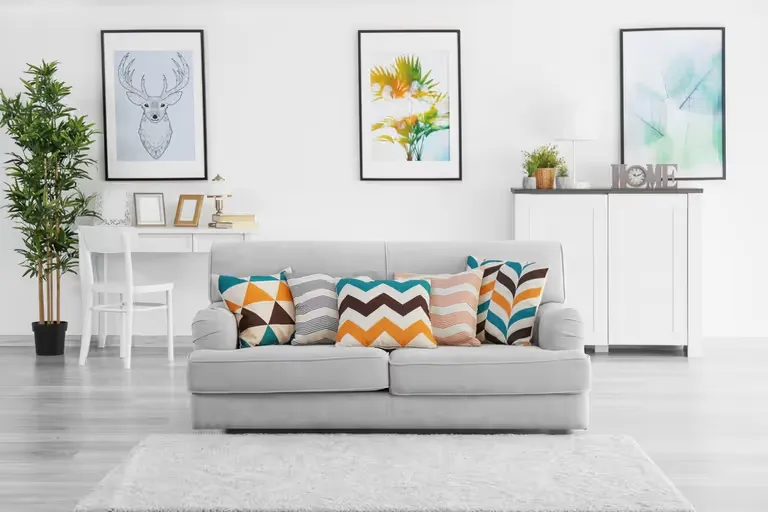
A messy living room is not really a cleaning problem. It is a clearing problem wearing a cleaning problem's clothes, which is why people stand in the doorway with a cloth in their hand and no idea where to put it down.
Where do you start cleaning a messy living room?
Start by clearing, not by cleaning. Put a laundry basket in the middle of the room, walk the perimeter once, and drop into it every item that does not live in that room. You cannot dust a surface you cannot see, and clearing first is the whole difference between an hour and three.
Do not leave the room while you do this. The single biggest time sink in cleaning any space is carrying one item to where it belongs, getting distracted by that room, and coming back twenty minutes later. The basket stays, the room gets finished, and the basket gets emptied at the end.
While you are walking the perimeter, do the three-second sorting most people put off:
- A trash bag in one hand for wrappers, dead flowers, junk mail and pens that do not write
- The basket for everything that belongs in another room
- A small pile for things that live in this room but are out of place, which go back last
How do you clean a messy room fast?
Twenty minutes, in a fixed order, with no stopping to put things away. Clear into a basket, straighten the soft things, dust high to low with a dry microfiber cloth, wipe the coffee table and any glass, then vacuum. Speed comes from never changing rooms and never re-deciding.
If someone is arriving and you have twenty minutes, that is the whole plan. Here it is broken down, roughly by minute:
- Minutes 1 to 6 — clear. Trash bag and basket, one lap of the room.
- Minutes 7 to 9 — soft things. Cushions straightened and turned, throws folded, rug edges flattened. This does more for how a room reads than anything else on the list.
- Minutes 10 to 14 — dust high to low. A dry microfiber cloth over shelves, the mantel, picture frame tops, lamp bases and side tables. Dry cloth, not spray, on wood and painted surfaces.
- Minutes 15 to 17 — glass and touch points. Coffee table top, any glass, light switch plates, door handles and the TV stand.
- Minutes 18 to 20 — vacuum. The open floor and the traffic path. Do not attempt under the sofa on a fast pass.
Two things not to do under time pressure. Do not start a job you cannot finish, such as pulling everything off a bookshelf. And do not wet-mop a hard floor at the end, because a damp floor and arriving guests do not mix.
What order should you clean a living room in?
Top down and dry before wet. Cobwebs and ceiling fixtures first, then shelves and the surfaces beneath them, then touch points, then floors last. Anything you dislodge falls onto something you have not finished yet, which is the entire reason floors are never cleaned first.
Dry before wet matters just as much. Dust lifted with a dry cloth comes away clean. Dust hit with spray first turns into a smear that has to be worked off, and on wood or painted trim that smear is what leaves streaks.
The full sequence, in order:
- Ceiling corners and cobwebs, then ceiling fan blades and light fixtures within safe reach
- Vents and registers, which are usually the dustiest thing in the room
- High shelves, the mantel, picture frames and artwork tops
- Mid-level surfaces: side tables, console, TV stand, lamp bases and shades
- Touch points: switch plates, door handles, door frames, remote controls
- Blinds, window sills and ledges
- Upholstery surfaces and cushions
- Baseboards, last of the vertical work
- Floors: vacuum thoroughly, then mop if the floor is hard and sealed
Nothing on that list requires standing above a two-step ladder. If a fixture or a corner is higher than that, leave it. Happy Maids does not work above a two-step ladder either, and a chandelier over a stairwell is a specialist's job rather than a stubbornness problem.
What is on a living room cleaning checklist?
A living room checklist is short, and the value is in doing all of it rather than most of it. Dust high to low, clean every touch point, vacuum upholstery and floors, and get the edges. The items people skip are always the same three: vents, baseboards, and the floor edge along the wall.
- Cobwebs in ceiling corners; vents and registers wiped
- Ceiling fan blades and light fixtures within reach
- Shelves, mantel, books and decor dusted, lifted and put back rather than dusted around
- Picture frames including the top edge; mirrors and glass tops cleaned
- Coffee table, side tables, console and TV stand
- Lamp bases and shades, dusted with a dry cloth or a soft brush
- Switch plates, door handles, door frames and the wall around the switch
- Window sills, ledges and blinds
- Sofa and chair surfaces vacuumed; cushions turned
- Baseboards along the full run of the room
- Floors vacuumed, then mopped if hard and sealed, including the edge along the baseboard
Television and computer screens are best left alone during a general clean. They need their own dry microfiber cloth and, if anything more, a cleaner made for screens. Household glass cleaner can damage an anti-glare coating permanently. Happy Maids leaves screens untouched for exactly that reason and dusts the cases, stands and shelves around them.
The same list, extended across every room in the house, is published as our room-by-room house cleaner checklist, including what changes on a deep clean.
How do you clean a sofa without ruining it?
Check the tag under a cushion before any liquid touches upholstery. Cleaning codes commonly read W, S, WS or X, and X means vacuum only — no water, no solvent, nothing. Test any product in a hidden spot first, blot rather than rub, and never soak the fabric.
Over-wetting is what actually ruins upholstery. Water that goes deeper than the fabric carries soil down into the foam, wicks back up as it dries and leaves a ring larger than the original mark, and on some fabrics it leaves a permanent water line.
- Vacuum first, with the upholstery tool, including under and behind the cushions where grit collects and abrades the fabric from inside.
- Read the code. W means a water-based cleaner, S means solvent only, WS means either, X means vacuum only.
- Test in a hidden place — the back of a skirt, under a cushion — and let it dry fully before deciding.
- Blot, do not rub. Rubbing pushes soil into the weave and can fuzz the surface permanently.
- Leather is its own thing. Dust it, wipe with a barely damp cloth, and use a product made for leather. Keep all-purpose cleaners and anything alkaline away from it.
Happy Maids vacuums sofa and chair surfaces as part of a standard visit, and vacuuming inside the sofa under the cushions is available as an add-on requested a business day ahead. Carpet and upholstery steam cleaning is not something Happy Maids does, and pointing you at a specialist is more useful than pretending otherwise.
How long does it take to clean a living room?
A living room kept up on a regular rhythm takes twenty to forty minutes on your own. One that has not been properly cleaned in a couple of months takes considerably longer, and nearly all of that difference is clutter to move and dust that has bonded to surfaces rather than sitting on them.
Four things drive the time, and only one of them is square footage:
- How much is on the surfaces. Every object is a lift, a dust and a put-back. A mantel with four things on it and a mantel with forty are not the same job.
- Soft flooring and rugs. Rugs trap grit and hold pet hair, and they need slow, overlapping passes rather than one quick lap.
- Pets and children. Hair on upholstery and fingerprints at knee height both add real minutes.
- How long since the last proper clean. Dust that has sat through a heating season sticks, and sticking dust has to be washed rather than dusted.
That last point is why a first visit from a cleaning service is usually a deep clean. You cannot dust a baseboard that was never washed, because the dust is stuck in a film and dusting only moves it around. Wash it once and every visit afterward holds it with a dusting, which is the logic behind the deep cleaning service.
How do you keep a living room from getting messy again?
Give the room a nightly ten-minute reset and give the things that pile up an actual home. A basket for throws, a tray for remotes, a drawer for cables, and a container by the door for anything leaving the house. Ten minutes a night beats two hours on a Saturday, every time.
There is a health argument too, not only an aesthetic one. The Asthma and Allergy Foundation of America recommends reducing clutter because dust collects on it, vacuuming weekly with a HEPA-filtered vacuum, and damp dusting rather than dry sweeping dust into the air.
Humidity matters as well. Both AAFA and the EPA's guide to indoor air quality put the target range at 30 to 50 percent, which in this climate means watching a humidifier in January and running air conditioning or a dehumidifier in August.
If the clutter is the real problem rather than the dust, the room-by-room method in our guide to decluttering a home is the place to start, because a living room with less in it is a living room that stays clean between visits.
What does a cleaning team do in a living room that you would not?
A team works the parts of a room you have stopped seeing. Picture frame tops, ceiling fan blades, vent covers, baseboards behind furniture, stair spindles one at a time, and the strip of floor along the wall where a vacuum normally does not reach. Order and thoroughness, rather than a secret product.
Happy Maids works top down and dry before wet, uses sealed-HEPA vacuums so that fine dust ends up in the machine rather than back in the air, and mops in detail into the corners and along the edges. Floors are mopped in detail rather than scrubbed on hands and knees, and hand work goes where it genuinely shows: doors, trim, baseboards and cabinet fronts.
Some things are outside the scope, and it is better to say so up front. Happy Maids does not move large or heavy furniture, with a published lifting limit of 25 pounds, does not wash walls or ceilings, does not work above a two-step ladder, and does not clean carpets or upholstery by steam. Incidental damage is handled as a credit toward future service and anything larger goes through insurance, with the exceptions and details set out on the policies page.
If you would rather the weekly reset was somebody else's job, the recurring maid service covers this room and every other one, and service areas lists the towns we cover. Before you book, the honest breakdown of what a cleaning service does with laundry and dishes is worth two minutes, because it is the question most people find out the answer to too late. Recurring service is a flat rate based on the size of your home, the services you choose and its condition; call 847-382-0082 and someone will work it out with you.
Frequently asked questions
Where should I start cleaning a messy room?
Start by clearing, not cleaning. Put a laundry basket in the middle of the room, walk the perimeter once, and drop in everything that belongs elsewhere. Do not leave the room to put things away until the room is finished, or the job doubles in length.
How do you clean a living room fast before guests arrive?
Twenty minutes in a fixed order: clear into a basket, straighten cushions and throws, dust high to low with a dry cloth, wipe the coffee table and glass, then vacuum the traffic path. Skip wet-mopping, and do not start anything you cannot finish.
What order should you clean a room in?
Top down and dry before wet. Cobwebs and fixtures, then high shelves, then mid-level surfaces, then touch points, then baseboards, then floors last. Everything you dislodge falls onto what is below it, so cleaning floors first guarantees doing them twice.
Do house cleaners move furniture to vacuum underneath?
Lightweight items are moved and put back. Large or heavy furniture is not, and Happy Maids has a published lifting limit of 25 pounds. Reachable areas under a bed or behind a sofa are vacuumed; anything requiring the piece to be moved is not part of a standard visit.
Do house cleaners clean TV and computer screens?
Happy Maids leaves screens alone deliberately. Household glass cleaner can permanently damage an anti-glare coating, and screens need their own dry microfiber cloth or a cleaner made for them. The cases, stands and shelves around the screen are dusted.
Do house cleaners shampoo carpets or upholstery?
No. Carpet and upholstery steam cleaning is outside what Happy Maids does, and it belongs to a specialist. Sofa and chair surfaces are vacuumed on a standard visit, and vacuuming inside the sofa under the cushions is available as an add-on.
What does the code on my sofa's care tag mean?
W means clean with a water-based product, S means solvent only, WS means either is safe, and X means vacuum only with no liquid of any kind. Whatever the code, test in a hidden spot first, blot rather than rub, and never soak the fabric.
Does clutter actually make a house dustier?
Yes. The Asthma and Allergy Foundation of America recommends reducing clutter specifically because dust collects on it, alongside weekly HEPA vacuuming and damp dusting. Fewer objects on a surface also means fewer things to lift and replace before that surface can be cleaned.