
Decluttering advice usually fails for one reason: it tells you to be ruthless without telling you where to stand when you start. A house does not get cluttered all at once, and it does not come back in a weekend either. What works is a small, repeatable method and somewhere for the results to go.
Happy Maids has been inside homes across Barrington and the Northwest suburbs since 1985, which is a long time to watch what actually holds. The homes that stay easy to live in are not the emptiest ones. They are the ones where every category has a home and something leaves the house every month.
Where should you start decluttering?
Start with the flat surface you look at most, not the closet that bothers you most. A kitchen counter, the dining table, the entry bench. A visible surface gives back a result in twenty minutes, and that visible result is what carries you into the rooms that take a full afternoon.
The instinct is to open the worst closet first, because that is where the guilt lives. It is also where momentum goes to die, because a closet takes hours and nobody sees the difference but you.
Work outward in roughly this order, and stop whenever you have had enough. Nothing here has to be finished in one sitting.
- Horizontal surfaces — counters, tables, the entry bench, nightstands, the top of the dresser
- Floors — anything living on the floor that should not be, in every room
- Drawers and cabinets — one drawer at a time, kitchen and bathroom first
- Closets — clothing, then linens, then coats
- Storage — basement, garage, the boxes nobody has opened since the last move
How do you declutter a room, step by step?
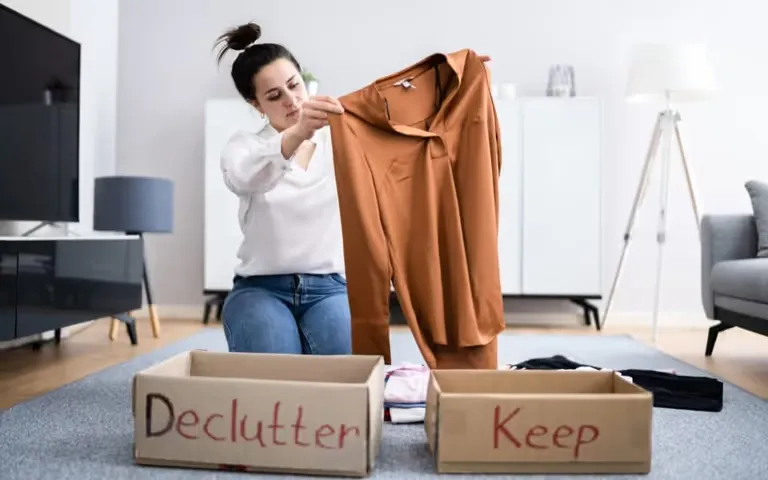
Work one room, and inside it one zone at a time — a single drawer, one shelf, one surface. Take everything out, wipe the empty space, then put back only what belongs there. Everything left over goes into one of four containers: keep elsewhere, donate, recycle, or discard.
Emptying the zone completely is the part people skip, and it is the part that does the work. Sorting inside a full drawer means comparing each item to the mess around it. Sorting into an empty drawer means asking whether it earns a place, which is a much harder question and a much better one.
The four-container method is old and it still holds. Label them, keep them in the room with you, and do not carry things off mid-zone — walking a single item to the basement is how an afternoon disappears.
- Keep, elsewhere — it belongs in the house, just not in this zone. It goes back at the end of the session, all at once.
- Donate — clean, working, and someone would genuinely want it.
- Recycle — paper, cardboard, accepted plastics, electronics, batteries.
- Discard — broken, stained, expired, or missing the part that made it useful.
One rule makes the whole thing faster: you only decide once. Anything that goes into the donate box does not come back out for a second look.
What is the fastest way to declutter?
The fastest way to declutter is a timed pass with the decision rule set before you start. Twenty minutes, one room, one bag for trash and one box for donations, and nothing gets reconsidered once it is in a box. Almost all of the time cost in decluttering is re-deciding.
A timer also puts a ceiling on the emotional load, which is the real reason a session stalls. Twenty minutes is short enough that you will do it again tomorrow, and doing it eleven days in a row beats one exhausting Saturday that never repeats.
Two more accelerants worth knowing. Handle paper standing over the recycling bin, so junk mail never lands on a counter in the first place. And when you cannot decide on a category — mugs, tote bags, cables — pick a number, keep your favorites up to that number, and let the rest go.
How do you decide what to keep?
Keep what you have used in the last year, what you would buy again today, and what you would genuinely miss. Let go of duplicates, clothing in sizes you are not wearing now, and anything kept for a hypothetical future. Sentimental items get their own box and their own day.
Separating sentimental items out is not procrastination, it is triage. Photographs, a child's artwork and a grandmother's linens are a different kind of decision, and mixing them into a session about kitchen gadgets stops the session cold.
A few questions that cut through faster than any rule:
- If it broke tomorrow, would I replace it, or feel relieved?
- Do I already own something that does this job better?
- Am I keeping this, or am I keeping the money I spent on it?
- Would I take this with me if I were moving next month?
That last one is a good calibrator, and it is why a move is such an effective forcing function. If a move is what prompted this, our move-in and move-out cleaning page covers what an empty house makes possible that a full one does not.
What goes on a room-by-room declutter checklist?
A declutter checklist works best as a list of the specific spots that reliably collect things, not a list of rooms. Below is the one worth working through. Each line is a zone you can finish in a single sitting, which is the only unit of decluttering that ever gets done.
Entry and mudroom
- Coats nobody has worn in a full season; single gloves
- Shoes past repair; the drawer of loose keys and old badges
- Bags, backpacks and reusable totes above the number you actually use
Kitchen
- Duplicate utensils, chipped mugs, lids without containers
- Small appliances that have not come out of the cabinet in a year
- Expired pantry items, spices past their date, freezer contents nobody can identify
- Takeout menus, loose cords, and the drawer everything lands in
Living areas
- Magazines and newspapers older than a month
- Decor on every surface — leave the pieces you actually like and store the rest
- Cables, remotes and chargers for devices you no longer own
- Books you will not read again; games with missing pieces
Bedrooms and closets
- Clothing that does not fit now, is stained, or needs a repair you will not make
- Hangers left empty; shoes worn out at the heel
- Nightstand drawers, which are where small clutter goes to hide
- Linens beyond the sets you rotate
Bathrooms
- Cosmetics and sunscreen past their date; sample sizes nobody used
- Old towels — worn ones make good rags or go to an animal shelter
- Expired medication, which should go to a pharmacy or police take-back box rather than down the drain
Laundry room, basement and garage
- Half-empty cleaning products, especially duplicates of the same thing
- Paint, solvents, pesticides and old batteries, which need proper disposal
- Boxes that have not been opened since the last move
- Hardware, spare parts and equipment for a project that ended years ago
Where does everything go once you have decided?
Get it out of the house within a week, or it moves back in. Donate what is clean and working, sell what is worth the effort, recycle what your hauler accepts, and take chemicals to a household hazardous waste collection. A donate box that sits in the garage for three months has not decluttered anything.
The EPA's guidance on reducing and reusing household goods is a good place to start: thrift stores, community centers, schools and nonprofits take books, working electronics, furniture and clothing, and donations to qualifying organizations may be tax deductible.
Chemicals are the part people get wrong, and they are the part that matters. Old cleaning products, solvents, pesticides and antifreeze should never go down a drain or into the household trash. The Illinois EPA household hazardous waste program runs free one-day collections each spring and fall and supports permanent year-round sites, including Naperville and Gurnee. A few specifics worth knowing before you load the car:
- Leftover paint goes to a PaintCare drop-off site rather than a hazardous waste event, because latex paint is not accepted at those collections.
- Lead-acid batteries are banned from Illinois landfills and go back to a retailer; other batteries can go through a mail-back recycling program.
- Used motor oil goes to a local recycler to be re-refined.
- Not accepted anywhere in that program: explosives, propane tanks, fire extinguishers and smoke detectors.
How do you keep a house from filling back up?
Give every category one home and a size limit, and keep a container by the door for outgoing items. Clutter accumulates at exactly the rate things come in minus the rate they leave. One outgoing box, emptied monthly, is what separates a house that stays decluttered from one that gets decluttered every spring.
Three habits do most of the work, and none of them takes real time:
- A drop zone that gets emptied. Keys, mail and bags land somewhere by the door whether you plan for it or not. Give them a tray and clear it nightly.
- Paper handled once. Open mail over the recycling bin. Scan what you need to keep and shred the rest.
- A ten-minute reset. One pass through the main rooms before bed, putting things back where they live. Ten minutes nightly beats three hours on a Saturday.
There is a practical payoff beyond the look of the place. Dust settles on clutter, and every object on a surface is another thing to lift and put back before that surface can be cleaned. Fewer objects is the cheapest cleaning upgrade there is.
Do house cleaners declutter or organize your home?
Happy Maids cleans, and does not declutter or organize. Cleaners will not decide what to keep, empty your closets or sort your papers, because those are your decisions and nobody else can make them. The published policy asks that floors be cleared before a visit, and excessive clutter can mean service is refused.
That reads as blunt written down, so here is the reasoning. A cleaner who spends the first half hour moving belongings has spent half an hour not cleaning, and you paid for a clean. The policy states it directly: not clearing floors may result in longer cleaning times and potentially additional fees.
What Happy Maids will do is work around what is there, and respect the boundaries you set. A home office you would rather nobody touched, a teenager's room, a guest room nobody uses — tell the office once and it goes on your file permanently. The full list of what is and is not included sits on the room-by-room cleaning checklist and the policies page.
If laundry, dishes and the rest of the personal-task list is what you are really trying to solve, the honest breakdown of what a cleaning service does with laundry and dishes is worth reading before you book anything. And once the clutter is down, our living room reset covers the fast weekly maintenance pass.
For a home that has been decluttered and now needs the deep work underneath it, see the deep cleaning service, or the recurring maid service to keep it there. Happy Maids covers Barrington and the surrounding Northwest suburbs, and 847-382-0082 reaches a person rather than a queue.
Frequently asked questions
Where should I start decluttering if the whole house feels cluttered?
Start with the flat surface you look at most — a kitchen counter, the dining table, the entry bench. A visible surface pays back in twenty minutes, and that visible result is what carries you into the closets and storage areas that take an afternoon.
How long should it take to declutter one room?
Plan in twenty-minute zones rather than rooms. A single drawer, one shelf or one surface is a zone. Most rooms are five to ten zones, and doing one a day for two weeks beats one exhausting Saturday that never repeats.
What is the four-box method?
Four labeled containers kept in the room with you: keep elsewhere, donate, recycle, and discard. Every item goes into one of them, and nothing comes back out. It works because it forces a decision on each item instead of letting you shuffle piles.
Where can I take household hazardous waste in Illinois?
Illinois EPA runs free one-day collections each spring and fall and supports permanent year-round sites, including Naperville and Gurnee. Leftover paint goes to a PaintCare drop-off instead, lead-acid batteries go back to a retailer, and explosives, propane tanks, fire extinguishers and smoke detectors are not accepted.
Do house cleaners organize or declutter your home?
Happy Maids cleans and does not declutter or organize. Cleaners will not decide what to keep, empty closets or sort papers. The published policy asks that floors be cleared before a visit, and excessive clutter may result in service being refused.
Should I tidy up before a cleaning service arrives?
Yes, though tidying is not cleaning. Clear toys, shoes and clothes from the floors and empty the kitchen sink. Not clearing floors may result in longer cleaning times and potentially additional fees, because a cleaner moving your belongings is a cleaner not cleaning.
Does decluttering really make a house easier to clean?
Yes, measurably. Every object on a surface is a lift, a dust and a put-back before that surface is finished. Dust also settles on clutter, so fewer objects means less dust to move and less time spent moving it.
Can I ask the cleaners to skip a room I have not sorted out yet?
Yes. A home office, a teenager's room, a storage room mid-project — tell the office once and it goes on your file permanently, so nobody has to remember to mention it on the day.