
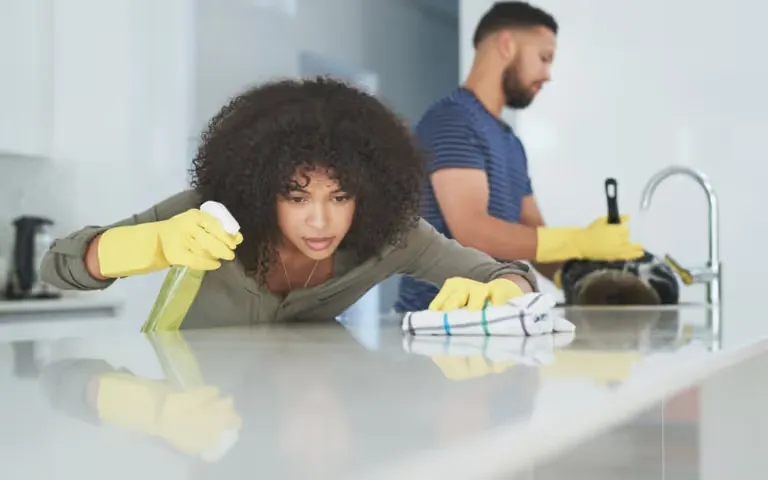
A kitchen gets dirty in a way no other room does, because it is the only room where you deliberately heat oil until it turns to vapor. That vapor settles as a film on everything above waist height, in a layer so gradual nobody notices it — until you wipe one square and see the line.
How do you deep clean a kitchen?
Deep clean a kitchen top down and dry before wet. Start every soak first — oven, hood filter, burner grates — so they work while you do everything else. Then cabinet tops and the hood, then upper cabinets and walls, then appliances and countertops, then the sink, and the floor last.
The reason for the order is mechanical rather than aesthetic. Anything you dislodge up high lands on whatever is below it, so finishing the floor early only means doing the floor twice.
A realistic sequence for one kitchen:
- Clear the counters completely, and move small appliances onto the table rather than shuffling them left and right
- Start the soaks — baking-soda paste in the oven, the hood filter in one sink basin, the burner grates in the other
- Work the high line: cabinet tops, the hood exterior, light fixtures, the tops of door casings
- Cabinet and drawer fronts, then the backsplash and the wall behind the range
- Appliance exteriors and handles, then inside the microwave and refrigerator
- Countertops, then the sink, drain and faucet
- Baseboards and the toe kick, then vacuum, then mop into the corners and along the edges
Set aside three to five hours for a kitchen that has not had this treatment in a year or two. A good part of that is dwell time you are not actually working through.
How do you clean an oven?
Coat the cool oven interior with a thick paste of baking soda and water, keeping it off the heating elements and the door gasket, and leave it overnight. Wipe it out with a damp cloth in the morning, then go over it once with a little white vinegar to lift the powder haze.
The racks come out and go into a bathtub lined with an old towel, covered with hot water and a squirt of grease-cutting dish soap, for an hour or more. The towel protects the tub finish, which is the part people tend to find out about the hard way.
If you would rather use the self-clean cycle, treat it as a small controlled fire inside your kitchen:
- Take the racks out unless your manual specifically says they can stay — most discolor permanently
- Open a window and run the hood, because the cycle smokes
- Move pet birds out of the house entirely; the fumes from a very hot self-clean cycle are dangerous to them
- Run it when you are home and not the night before a holiday, since the sustained heat is hard on older control boards
Never put a caustic oven spray on the door gasket, the window seal, or the interior of a self-cleaning oven unless the manual allows it. That coating is not the same enamel as an older oven, and the damage is permanent.
Happy Maids adds inside-the-oven cleaning on request on any service, with at least one business day of notice. Per our published policies, a self-clean cycle needs to finish the day before we arrive, and our technicians use a degreaser rather than a caustic spray. If you prefer a particular product, you can apply it yourself and we will wipe it down.
How do you clean a greasy stove top?
On a glass or ceramic cooktop, let the surface cool, then use a purpose-made cooktop cream and a single-edge razor scraper held almost flat. On a gas range, lift the grates and burner caps into a sink of hot water and dish soap and let them sit while you wipe the surface underneath.
Baked-on sugar is the one exception, because it pits the glass if it cools in place — take it off while the cooktop is still warm, wearing an oven mitt. Everything else waits until the cooktop is cool.
- Never use a powdered scouring cleanser or a green scrub pad on glass — it leaves a permanent haze of fine scratches
- Never put cast-iron grates through the dishwasher; the detergent strips the seasoning and they rust within days
- Dry burner caps completely and seat them properly, or the burner lights unevenly afterward
The knobs usually pull straight off. They wash in the sink in two minutes, and they are the greasiest thing in the room.
How do you clean a range hood filter?
Soak an aluminum mesh filter for about twenty minutes in a sink of very hot water with grease-cutting dish soap and a few tablespoons of baking soda, then rinse it and let it dry fully before it goes back. Repeat the soak rather than scrubbing hard, because the mesh crushes easily.
Do not run mesh filters through the dishwasher. Automatic dishwasher detergent is strongly alkaline and oxidizes aluminum, turning the filter a dull gray-black that never comes back.
Recirculating hoods that vent back into the room also hold a charcoal filter behind the mesh. That one gets replaced rather than washed, roughly every six months to a year depending on how much you cook.
How do you clean a microwave?
Put a bowl of water with a few lemon slices inside, run it on high for four to five minutes, then leave the door shut for another three. The steam softens everything baked onto the walls, and the interior then wipes out with a damp cloth and no chemical at all.
Use lemon slices, a splash of vinegar or a wooden spoon in the bowl. Plain water in a very smooth container can superheat and erupt when you move it.
The turntable and its roller ring wash by hand in the sink. The two places people miss are the ceiling of the cavity, where splatter collects out of sight, and the vent grille along the top of the door.
Microwave cleaning, inside and out, is on the standard Happy Maids room-by-room cleaning checklist for every service — recurring, deep clean and move-out alike.
How do you clean inside a refrigerator?
Empty one shelf at a time and wash with warm water and either a little dish soap or a tablespoon of baking soda per quart. Let glass shelves come to room temperature on the counter before they meet hot water, because thermal shock can crack them. Dry everything before it goes back in.
Skip bleach, ammonia and abrasive cleansers inside a refrigerator. It is a sealed box that holds food, plastic liners craze, and the smell lingers for days.
Three things account for most refrigerator odor:
- The crisper drawers, which usually have liquid sitting under the removable base
- The door gasket folds, which need a soft brush and warm soapy water
- The drip pan underneath at the front, reachable on many models once the toe grille pops off
An open box of baking soda helps afterward, but only once the source is gone. Keep the refrigerator at or below 40 degrees Fahrenheit and the freezer at zero, and wipe spills the day they happen rather than at the next deep clean.
Inside-the-refrigerator cleaning is an add-on with Happy Maids, arranged at least one business day ahead. The office asks that the refrigerator be as empty as you can reasonably make it, which in practice means not doing the big grocery run the day before.
How do you clean a dishwasher?
Start with the filter, not with a cycle. Twist out the cylindrical filter in the floor of the tub, rinse it under the tap, and work the mesh with an old toothbrush and dish soap. That one part is responsible for most of the smell and most of the film left on glassware.
Then wipe the door gasket and the lip below the door, clear the spray-arm holes with a toothpick, and run the hottest cycle empty with a dishwasher cleaner.
On vinegar: it is popular advice, and several manufacturers advise against it specifically, because prolonged acid contact degrades rubber seals and can dull the interior. Check your own manual before making it a routine.
Cleaning inside a dishwasher is on the Happy Maids list of exclusions, along with the washing machine and dryer. Our technicians clean the exterior and the handle on every visit and can help load the dishwasher, but the inside of the machine stays yours.
How do you clean a garbage disposal?
The smell is almost never down in the grinding chamber. It is on the underside of the rubber splash guard at the top, which traps everything that passes through it. Switch the disposal off, fold the flaps back, and scrub both faces with an old toothbrush and dish soap.
After that, run cold water and grind a tray of ice cubes with a handful of coarse salt, which scours the chamber walls. A few strips of lemon or orange peel afterward are for the scent, not for the cleaning.
- Never put your hand into a disposal, even with the switch off at the wall
- Never pour bleach or chemical drain cleaner into one — both attack the seals and can splash back
- Keep grease, fibrous peels, pasta, rice and coffee grounds out of it, since those build the layer that smells
How do you clean a stainless steel sink?
Wash the basin with dish soap first, then use a mild powdered cleanser containing oxalic acid on a damp cloth, rubbing with the grain of the steel rather than in circles. Rinse thoroughly, then dry the whole basin and the faucet with a towel. The drying is what keeps the finish even.
- Never use steel wool or a green scouring pad — they leave iron particles behind that rust as orange freckles
- Never leave bleach standing in a stainless basin, because it pits the surface
- Lift rubber sink mats and dish racks out daily, since standing water underneath discolors the steel
The chalky white film around the base of the faucet is mineral deposit rather than soap. The water out here is hard, and a cloth soaked in white vinegar laid on a stainless or chrome fixture for fifteen minutes, then rinsed and dried, softens it. Keep that same vinegar well away from natural stone, which it etches.
Happy Maids does not clean hard water or mineral buildups that require more than standard cleaning supplies and tools. That limit is published in our policies, and we would rather state it than imply otherwise.
What our technicians do is dry the sink, faucet and fixtures by hand on every visit, which is what stops the film from establishing in the first place. On a home where it has already built, it comes off a layer at a time over several visits rather than in one, because we will not reach for an abrasive pad or an aggressive chemical that would dull the finish permanently. There is more on how mineral buildup behaves in our post on hard water stains and what actually shifts them.
What should you use on quartz and granite countertops?
Use warm water with a mild detergent on a soft cloth, then rinse and dry, on both quartz and granite. Neither needs a specialty spray for everyday work. What ruins them is the same short list: acids, strong alkalis, abrasive pads, and anything left sitting long enough to dry.
Caesarstone's own care and maintenance guidance for quartz surfaces says exactly that — warm water and a mild detergent, wipe wet spills before they mark, use trivets under hot cookware, and treat high or low pH chemicals with caution.
Granite and marble are natural stone and porous, so the rules are stricter:
- No vinegar, lemon or any acidic cleaner — acid etches the polish permanently and no amount of buffing brings it back
- No bleach or ammonia; use a pH-neutral stone cleaner instead
- Test the seal every few months by leaving a few drops of water on the surface — if the stone darkens within fifteen minutes, it wants resealing
If you are choosing products for the whole kitchen, the EPA's Safer Choice certified product list is searchable by product type and is a straightforward way to find cleaners that have been reviewed against a published ingredient standard.
How do you clean kitchen tile and grout?
Make a paste of oxygen bleach powder and warm water, or of baking soda and water, spread it along the grout lines, let it dwell ten minutes, then work it with a stiff nylon brush and rinse well. Repeat the same treatment rather than escalating to something stronger.
Acid-based grout cleaners are sold everywhere and they do work, but on cement grout they erode the surface over time and on natural stone tile they etch the tile itself. Eroded grout then holds dirt faster than it did before.
Never mix bleach with ammonia or with an acidic cleaner. The combination produces genuinely dangerous gas, and it usually happens when someone reaches for two products back to back in a small kitchen.
For the floor itself, a well-wrung mop and warm water with a suitable cleaner is enough. Do not wet-mop unsealed or unfinished wood, and get into the toe kick under the cabinets, where crumbs and grease meet.
What does Happy Maids clean in a kitchen, and what is extra?
Happy Maids cleans the kitchen on every visit: counters and backsplash, sink and drain, cooktop and range front and knobs, the microwave inside and out, appliance exteriors and handles, cabinet fronts, table and chairs, switches and fixtures, sills and blinds, the bin, and the floor vacuumed and then mopped.
Four kitchen jobs are add-ons rather than inclusions on any service, including a move-out, and they need at least one business day of notice: inside the oven, inside the refrigerator, inside the cabinets with the cabinets emptied, and interior windows within step-ladder reach. They are commonly added on a move-out, and nearly everyone takes them.
The difference between a recurring visit and a deep clean is the verb, not the list. On a recurring visit cabinet fronts are spot-cleaned where marks show; on a deep cleaning service the whole cabinet front is hand-washed, including the grease film above the range, and baseboards, trim and doors are hand-washed rather than dusted. Our room-by-room checklist sets the two out side by side, and the difference between a maintenance clean and a deep clean goes through it in more detail.
A deep clean, a move-in/out and a post-remodel clean are charged by the time required, hourly and pro-rated for every ten minutes. A recurring maid service is a flat, predictable rate set by the size of the home, the services chosen and its condition. For a number on your own kitchen, call 847-382-0082 and describe the house.
Two limits are worth knowing before a visit. Our technicians work from a two-step ladder, so the very top of a tall cabinet run may be reached with an extension pole rather than hand-washed, and we ask that you not cook right before or during the appointment, because we do not handle hot stoves.
Happy Maids has cleaned kitchens in Barrington and the surrounding northwest suburbs since 1985. If the film above your range has stopped responding to an ordinary wipe, that is the point where a deep clean earns its keep — and how you approach the grease on the cabinet doors themselves matters far more than how hard you press.
Frequently asked questions
How often should you deep clean your kitchen?
Deep clean a kitchen twice a year, and do the appliance interiors on their own schedule: the microwave weekly, the refrigerator every three months, the oven and the hood filter every three to six months depending on how much you fry. Daily wiping of counters and the cooktop is what keeps the twice-yearly job manageable.
How long does it take to deep clean a kitchen?
Allow three to five hours for a kitchen that has not been deep cleaned in a year or more, working alone. Much of that is dwell time while the oven paste, the hood filter and the burner grates soak, so the actual hands-on work is closer to two hours if you start the soaks first.
How do you get rid of a smell coming from the kitchen sink?
Check three places in order: the underside of the disposal splash guard, which traps food and is the usual culprit; the drain basket and strainer; and the P-trap under the sink if the smell persists. Scrub the splash guard with an old toothbrush and dish soap, then grind ice and coarse salt with cold water running.
Can you use vinegar on granite or quartz countertops?
No. Vinegar is acidic, and on granite or marble it etches the polished surface permanently — the dull patch cannot be buffed out. On quartz, manufacturers advise caution with high and low pH chemicals. Warm water with a mild detergent, rinsed and dried, is the correct everyday clean for both.
How do you clean a stainless steel sink without scratching it?
Wash with dish soap, then use a mild powdered cleanser containing oxalic acid on a damp cloth, rubbing with the grain of the steel rather than in circles. Rinse well and dry with a towel. Avoid steel wool and green scouring pads entirely, since they embed iron particles that later rust as orange spots.
How do you clean a range hood filter?
Soak the aluminum mesh filter about twenty minutes in very hot water with grease-cutting dish soap and a few tablespoons of baking soda, then rinse and dry it completely before refitting. Do not use the dishwasher — the alkaline detergent oxidizes aluminum and permanently dulls the mesh to a gray-black.
Does Happy Maids clean inside the oven and refrigerator?
Yes, as add-ons rather than as part of a standard visit, on any service including a move-out. Both need at least one business day of notice. Any self-clean cycle should finish the day before we arrive, and the refrigerator should be as empty as you can reasonably make it before the appointment.
Does Happy Maids remove hard water stains in the kitchen?
No. Our published policies state that we do not clean hard water or mineral stains or buildups that require more than standard cleaning supplies and tools. Our technicians dry the sink, faucet and fixtures by hand on every visit, which prevents the film from establishing, and on existing buildup it lightens gradually over several visits with standard supplies.