
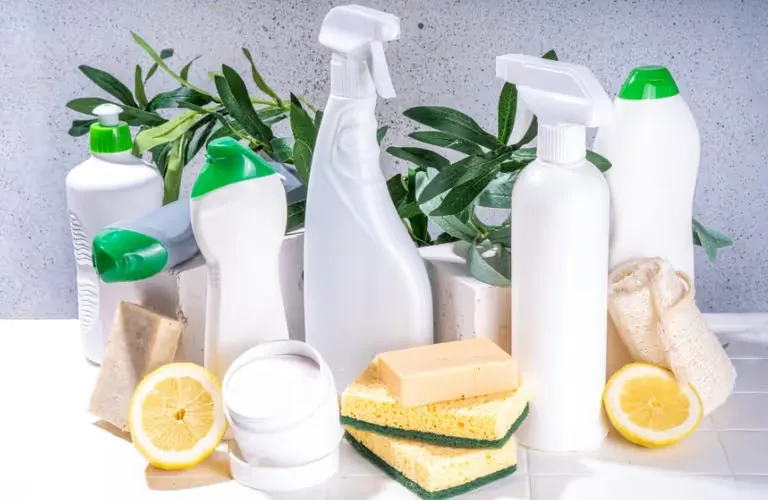
Walk down the cleaning aisle and half the bottles are green, leaf-printed and promising something. Almost none of those promises mean anything in law. Understanding which words are enforceable, and which are decoration, is most of what separates a useful purchase from an expensive one.
This is the plain version: what green cleaning means, what a non-toxic product actually is, whether plant-based cleaners disinfect, and what a bottle of Lysol does and does not do to the dust mites in your mattress. Happy Maids has been cleaning homes around Barrington since 1985, and these are the questions clients ask most often once the subject comes up.
What is green cleaning?
Green cleaning means cleaning with products and methods chosen to reduce harm to the people in the house and to the water and air outside it. In practice that means fewer volatile solvents, biodegradable surfactants, less packaging, and ingredients screened against a published safety standard rather than picked for scent and price.
The phrase covers method as much as chemistry. Microfiber that lifts soil mechanically, a vacuum with a sealed filter that does not exhaust dust back into the room, and correct dilution all reduce how much product a house needs in the first place. A cleaner used at four times the label strength is not green regardless of what the front of the bottle claims.
What green cleaning is not is a legal category. There is no federal definition of a "green" cleaning product, so the word on its own is not something a shopper can check. What can be checked is the EPA's Safer Choice standard, which is why the certification below is worth more than the adjective.
What is a non-toxic cleaning product?
"Non-toxic" is a marketing word with no regulatory meaning; a product that lists every ingredient and carries no signal word is the practical version of it. We work through it in our guide to what "non-toxic" means on a cleaning label.
Are Method and Mrs. Meyer's cleaning products non-toxic?
They are better disclosed than most of the shelf and still not free of fragrance, which is the ingredient most people are actually trying to avoid. We work through it in our guide to how the mainstream green brands hold up to their labels.
Do green cleaning products disinfect?
A green cleaner removes soil and the germs that travel with it; killing what remains needs an EPA-registered disinfectant and enough dwell time to work. We work through it in our guide to the difference between cleaning and disinfecting a home.
Does Lysol kill dust mites?
A disinfectant spray is not a dust mite strategy: what people react to is a protein in mite waste, and that protein stays in the fabric after the mite is dead. The detail sits in our guide to whether Lysol kills dust mites.
Do green cleaning products actually work?
For everyday soil, yes. Removing grease and grime is surfactant chemistry, and plant-derived surfactants do that job well. Where plant-based products genuinely fall short is heavy degreasing, sanitizing without an EPA registration, and mineral deposits, which need either a specialist product or patience.
Honesty about the limits is what makes the rest credible. Happy Maids does not clean hard water or mineral stains or buildups that require more than standard cleaning supplies and tools, and no plant-based spray changes that. What does change it is frequency: surfaces that get attention every visit never reach the state where an aggressive product looks necessary.
How do you make non-toxic cleaning products at home?
Warm water with dish soap, diluted vinegar for glass, and baking soda as a gentle scrub cover most of a house — and vinegar must stay off natural stone and never meet bleach. We work through it in our guide to the homemade cleaners that actually work, and the mixes to avoid.
How do you clean baseboards with vinegar?
Warm water and a drop of dish soap on a barely damp cloth lifts the greasy film that dust bonds to; vinegar is fine on painted trim but has no advantage over soap. We work through it in our guide to what to clean baseboards with.
What does Happy Maids use?
Happy Maids brings all tools and supplies to every visit. Better Life leads, a plant-derived line with no dyes, synthetic fragrances, sulfates or petroleum solvents, alongside a peroxide cleaner, a bathroom cleaner, Bar Keepers' Friend and two bleach-containing products used for stains and scouring.
Every one of them is listed by name on the green cleaning page rather than summarized as eco-friendly, which is the test this whole article has been describing: a named list you can check beats an adjective you cannot. Technicians are trained on those products and are instructed to use only them, which is a quality decision rather than a preference.
If you ask for something of your own to be used, the published policy is explicit: Happy Maids cannot assure its usual standard of cleaning with client-supplied products, and cannot be held responsible for damage to surfaces or equipment. If there is a product you would rather was not used in your home, raise it with the office when you schedule — call 847-382-0082. The full terms sit on the policies page.
Where this leaves you
Green cleaning is worth doing, and it is worth doing without illusions. Certified formulas reduce what your household breathes and what goes down the drain, correct dilution does more than brand choice, and a clean surface beats a disinfected dirty one every time. The limits are real, and knowing them is what keeps the rest honest.
If you would rather hand the whole routine to someone who already works this way, Happy Maids has been doing it in Barrington and the surrounding towns since 1985. Call 847-382-0082, or read what a standard visit covers on the house cleaning and deep cleaning pages.
Frequently asked questions
What does green cleaning mean?
Green cleaning means using products and methods chosen to reduce harm to the people in the home and to the water and air outside it: biodegradable surfactants, fewer volatile solvents, less packaging, and correct dilution. It is not a legal category, which is why third-party certification matters more than the word on the label.
What is a non-toxic cleaning product?
There is no regulated definition of non-toxic for household cleaners in the United States, so the phrase carries no guarantee. The closest thing to a real standard is the EPA's Safer Choice label, which reviews every ingredient in a formula against published criteria before the label can be used.
Are Mrs. Meyer's cleaning products actually non-toxic?
Mrs. Meyer's is an ordinary detergent-based cleaner built largely on plant-derived ingredients and scented with essential oils, and it publishes its ingredient list. No brand can be certified non-toxic because no such certification exists. To check any specific product, search it in the EPA's Safer Choice database.
Are Method cleaning products non-toxic?
Method products are conventional cleaners built largely on plant-derived ingredients, with published ingredient lists. Non-toxic is not a certified category in the United States, so the useful question is whether a given product appears in the EPA's Safer Choice list, which you can search by company name in about a minute.
Do green cleaning products disinfect?
Most do not, and legally they cannot claim to. Any product that kills bacteria or viruses is regulated as a pesticide and must carry an EPA registration number on the label. Registered disinfectants with gentler actives do exist, including hydrogen peroxide, citric acid, lactic acid and thymol.
Does Lysol kill dust mites?
No. Lysol's sprays and wipes are registered to kill bacteria and viruses on hard surfaces. The dust mite language on some labels is an allergen claim about mite matter, the debris left behind, not a claim to kill the mites, which live deep inside mattresses, pillows and carpet.
Are green cleaning products as effective as regular ones?
For everyday soil, yes, because removing grease and grime is surfactant chemistry and plant-derived surfactants do it well. The genuine gaps are heavy degreasing, disinfecting without an EPA registration, and mineral deposits, which need either a specialist product or repeated attention over several visits.
Where can I buy green cleaning products?
Almost every grocery store, hardware store and online retailer now carries them, so availability is no longer the problem; sorting real claims from marketing is. The most reliable shortcut is to search the EPA's Safer Choice product list first, then buy whichever certified option your store stocks.